Last verified: May 2026 | Reading time: 9 minutes
You’ve probably Googled “SEO content writing services” and landed on a page quoting anywhere from $50 to $5,000 per article. No explanation. No context. Just a number floating in white space, daring you to make sense of it.
That ambiguity costs businesses money — either they underpay for content that never ranks, or overpay for polished prose that ignores how search actually works in 2026.
This post fixes that. You’ll leave knowing exactly what quality SEO content costs, how long it realistically takes, what questions to ask before signing anything, and — critically — why the content you publish today will outperform something equally good published six months ago.
What Is SEO Content Writing, Actually? (And What It Isn’t in 2026)
Quick answer: SEO content writing is the craft of producing articles, landing pages, and FAQs structured to rank on Google and appear in AI-generated answers on Perplexity, ChatGPT Search, and Google’s AI Overviews. In 2026, it means satisfying both a crawler and a language model simultaneously.
Here’s the distinction most agencies gloss over: traditional copywriting persuades. SEO copywriting also gets found. You need both — but most services optimize for one and call it the other.
Think of it this way: a great restaurant with no signage starves. SEO content is the signage. Exceptional SEO content is signage and a Michelin star listing.
How Much Does SEO Content Writing Cost in 2026?
Quick answer: Professionally written, SEO-optimized blog posts range from $150–$600 for standard 1,000–1,500-word articles. Long-form, research-backed content (2,500+ words with schema and AEO structuring) runs $600–$2,500. Fully managed monthly retainers cost $1,500–$8,000+/month depending on volume and vertical.
Here’s the pricing breakdown no one shows you cleanly:
| Content Type | Word Count | Price Range (USD) | Turnaround |
|---|---|---|---|
| Basic blog post | 800–1,200 | $80–$180 | 3–5 days |
| Standard SEO article | 1,200–1,800 | $150–$400 | 5–7 days |
| Long-form pillar page | 2,500–4,000 | $500–$1,200 | 7–14 days |
| AEO-optimized FAQ post | 1,500–2,500 | $300–$800 | 7–10 days |
| Full content strategy + execution | Monthly retainer | $1,500–$8,000+ | Ongoing |
Elevate your digital presence.
Ready to transform your content strategy? Our expert team delivers SEO-optimized blogs, thought leadership, and authority-building content that drives real, compounding results.
Boost your content strategyThe pratfall effect in action: The best agencies will tell you upfront that some of their posts don’t rank in the first 90 days. That candor is a trust signal — not a red flag. Any service guaranteeing first-page rankings within 30 days is selling you something that doesn’t exist.
Why “cheap” content costs more long-term: A $50 article that earns zero traffic costs you $50 plus the opportunity cost of that slot. A $400 article ranking for a $200 CPC keyword pays itself back within weeks. The question isn’t what content costs — it’s what not ranking costs.

What Do You Actually Get for That Price?
Quick answer: At the $150–$400 range, expect keyword research, one draft, basic on-page optimization, and meta copy. At $500–$1,200, expect competitor gap analysis, semantic clustering, internal link recommendations, FAQ schema, and at least one revision round. Premium tiers include original data, expert interviews, and quarterly refresh cycles.
Most buyers compare deliverables wrong. They count words. Count signals instead:
- Does the writer reference primary sources with live hyperlinks?
- Is the FAQ section formatted for schema markup?
- Does the outline account for questions people actually type into Perplexity?
- Is there a freshness plan — or does the piece get published and forgotten?
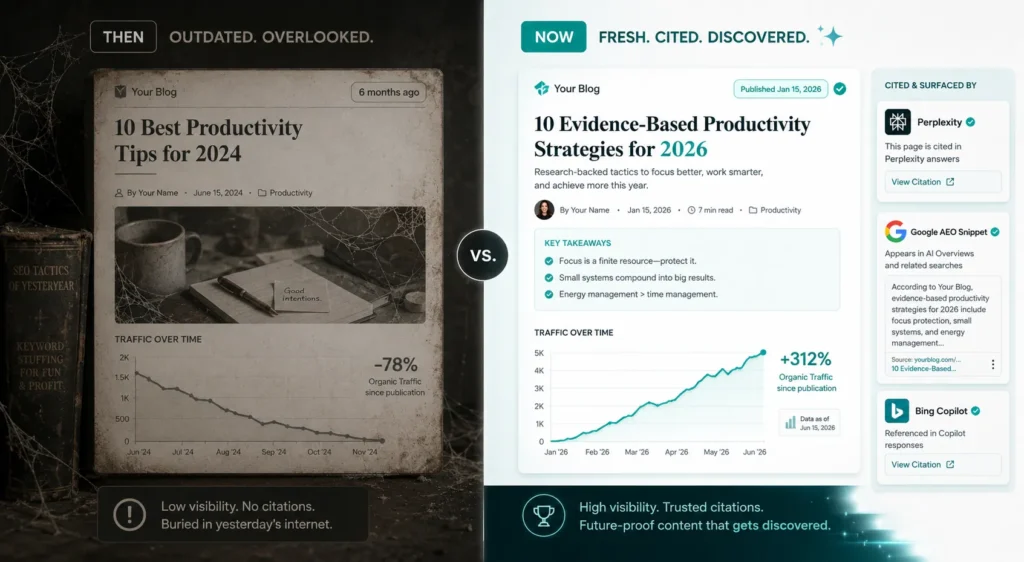
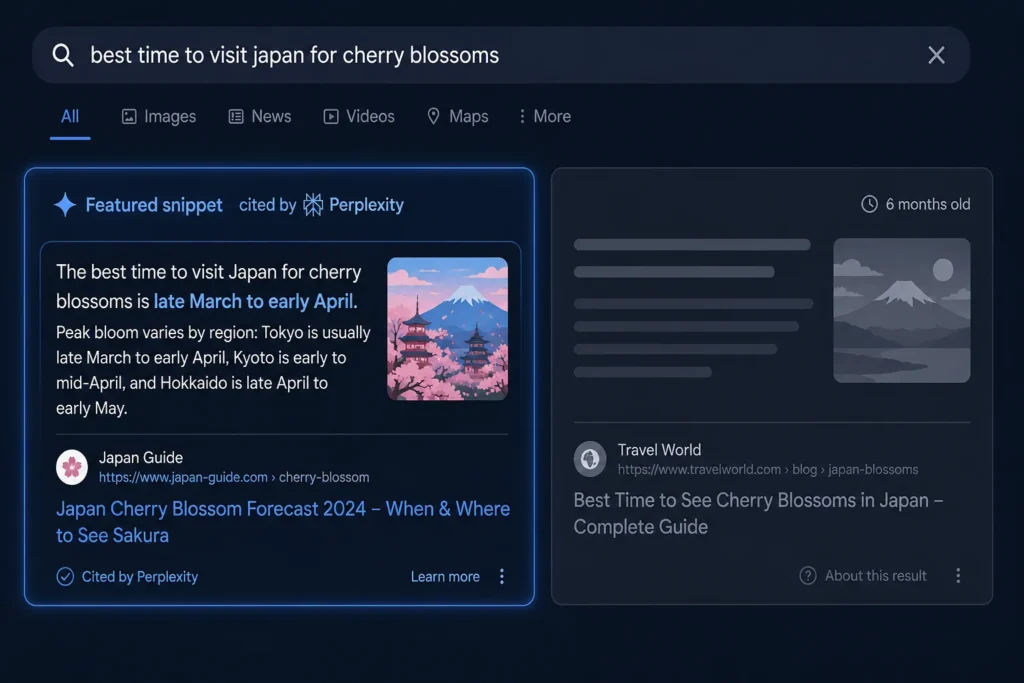
That last point matters more than anything else in 2026. Perplexity, Copilot, Gemini and ChatGPT cite content that is atleast 25% fresher, according to an analysis of AI citation behavior. A six-month-old post on an identical topic loses — consistently — to a fresher piece, even with fewer backlinks.
You’re not buying an article. You’re buying a living asset that needs quarterly maintenance.
How Long Does SEO Content Take to Produce?
Quick answer: A properly researched, outlined, written, and optimized SEO article takes 5–14 business days from brief to publish-ready draft. Rush timelines under 72 hours sacrifice either research depth or optimization quality. Expect 2–4 weeks for pillar pages requiring original data.
The IKEA effect is real here: clients who participate in the brief process — sharing customer questions, objections, and product nuances — consistently rate the output higher and see stronger rankings. Your context is irreplaceable. Writers who skip the discovery call are cutting corners you’ll feel in the metrics.
Realistic production timeline for a 2,000-word AEO post:
- Day 1–2: Keyword and SERP research, competitor gap audit
- Day 2–3: Outline approval (this step gets skipped dangerously often)
- Day 4–7: Draft with sources, schema-ready FAQ, meta copy
- Day 8–10: Revision round + internal link mapping
- Day 11–14: Final proof, image alt text, publish brief
Agencies promising this in 48 hours are either recycling existing drafts or using unreviewed AI output. Neither ranks reliably.
What Is AEO and Why Does It Change Everything About Content Strategy?
Quick answer: Answer Engine Optimization (AEO) structures content to appear in AI-generated responses from Perplexity, ChatGPT Search, Google AI Overviews, and voice assistants. Unlike traditional SEO targeting blue links, AEO targets the zero-click answer box — making your content the source AI cites directly.
Here’s the reframe most marketers need: Google isn’t your only audience anymore. In May 2025, Perplexity was processing over 780 million queries per month, and ChatGPT Search had become a default research tool for millions of professionals. Understanding how ChatGPT and Perplexity decide what to cite is now as strategically important as knowing how Google’s PageRank works — your content either feeds those systems or gets filtered out by them.
AEO-optimized content has specific structural requirements:
- H2 questions phrased exactly as users type them
- 40–60 word answers immediately below each H2 (the snippet sweet spot)
- Supporting data tables that give AI systems clean, structured facts to lift
- FAQ schema markup signaling to crawlers that these answers are authoritative
- Publication recency — freshness isn’t a vanity metric, it’s a citation prerequisite
One well-structured FAQ post can capture AEO snippets across a dozen simultaneous queries. That’s not an exaggeration — it’s the documented behavior of how Perplexity and Google’s AI Overview both pull answers.

What Questions Should You Ask Before Hiring Any Content Service?
Quick answer: Ask: Do you provide schema markup? How do you handle quarterly refreshes? Can you show me a post you’ve written that currently holds an AI Overview snippet? What’s your process for updating posts when data changes? If they can’t answer confidently, keep searching.
The scarcity framing here is genuine, not manufactured: writers who understand both traditional SEO and AEO structuring are rare. Most content mills train for volume. AEO requires a different skill set — understanding how language models weight authority signals, recency, and structured data simultaneously.
Red flags in any content writing proposal:
- No mention of schema or structured data
- No refresh or update policy
- Guarantees tied to rankings rather than process quality
- No outline approval step before writing begins
- Word count used as the primary quality metric
Green flags:
- They ask about your customer’s real questions before writing
- They reference competitor content gaps, not just keyword volumes
- They build quarterly refresh cycles into pricing
- They distinguish between content that ranks and content that gets cited by AI
Do You Need a Monthly Retainer or Per-Project Pricing?
Quick answer: Per-project works for one-off pillar pages or product launches. Retainers make sense when you need 4+ pieces monthly and want consistent brand voice, internal linking strategy, and quarterly refreshes built into the workflow. Most businesses producing serious content ROI spend $2,000–$5,000/month.
The paradox of choice is real: don’t let a menu of 12 packages slow this decision. Here’s a clean filter — and if you’re an SMB trying to figure out how small businesses structure content budgets without overspending, that breakdown will help you benchmark before committing to any tier:
- Publishing fewer than 2 posts/month? Per-project.
- Building topical authority in a competitive vertical? Retainer.
- Launching a new site or rebranding? Project-based strategy sprint first, then retainer.
The hyperbolic discounting trap catches most buyers here — they choose the cheaper per-post option because the monthly total looks smaller, not realizing a retainer’s consistency compounds authority faster. A content program running for 12 months at $2,500/month typically outperforms 30 disconnected articles bought over 18 months at $200 each.
How Do You Measure Whether SEO Content Is Actually Working?
Quick answer: Track organic impressions (Google Search Console), featured snippet captures, AI citation frequency, and time-on-page rather than just rankings. A post ranking #4 for a question Google answers via AI Overview may earn more brand awareness than a #1 ranking for a non-AEO-formatted post.
The emotional anchor most marketers need: traffic is a lagging indicator. A well-structured post published today won’t show meaningful impression data for 8–12 weeks on average. Measuring at week 3 and concluding “it didn’t work” is like weighing yourself the morning after starting a new eating plan.
Metrics worth tracking per post:
| Metric | Tool | What It Signals |
|---|---|---|
| Impressions growth | Google Search Console | Crawl health + index momentum |
| Featured snippet wins | SEMrush / Ahrefs | AEO formatting quality |
| AI citation appearances | Perplexity manual checks | Authority + recency signals |
| Time on page | GA4 | Content depth + relevance |
| Scroll depth | Hotjar / Clarity | Structural engagement |
Once you’ve got traffic coming in, the next question is conversion — and that’s where credibility signals that convert zero-click readers into leads become the missing piece most analytics dashboards never surface. Rankings tell you who arrived. Credibility architecture determines who stays and acts.
Why Freshness Isn’t Optional: The 2026 Content Decay Problem
Here’s something most content agencies won’t tell you because it threatens their model: a post published today begins depreciating immediately.
Google’s freshness algorithm actively rewards recently updated content for queries with time-sensitive intent. “SEO content writing costs 2026” isn’t a static query — someone searching it in November 2026 wants November data, not May estimates.
More pointedly: Perplexity’s documented preference for content published within the previous 30 days means a post ranking well in June may hemorrhage AI citations by October if left untouched. This is the same force driving zero-click search behavior that makes freshness non-negotiable — when AI engines serve answers directly from your page, they prioritize the most recently verified source. An older post, however authoritative, loses that citation slot to a fresher competitor covering identical ground.
The fix is a Quarterly Content Refresh Protocol:
- Update all statistics with current sources
- Add or revise FAQ entries targeting new search questions
- Check and repair broken outbound links
- Re-submit the URL to Google Search Console
- Update the published/modified date only after making substantive changes (cosmetic date bumps without content changes actively harm credibility)
Agencies that don’t offer this as a service are selling you a car without maintenance — it works until it doesn’t.
The Ben Franklin Effect and Why Getting Readers to Do One Small Thing Compounds Authority
There’s a documented psychological phenomenon: when you ask someone to do you a small favor, they become more favorable toward you — not less. Applied to content, it means every micro-action a reader completes (bookmarking, sharing a section, using one tip) deepens their investment in your brand.
This is why the best SEO content isn’t structured as a monologue — it’s structured as a series of small invitations. “Use this table to benchmark your current spend.” “Try this question in your next agency briefing.” “Check your last five posts against this schema checklist.”
Each action activates the IKEA effect: they’ve put something of themselves into your framework. They’ll remember it. They’ll return. They’ll cite it.
What to Do Right Now (Not “Eventually”)
You’ve read enough to make a sharper decision than 90% of buyers in this market. Here’s your next 20 minutes:
- Audit your last 5 published posts — do any have FAQ schema? If not, that’s fixable today using Google’s Structured Data Markup Helper.
- Check publication dates — anything older than 90 days covering a data-sensitive topic (costs, tools, platforms, AI behavior) needs a refresh before it loses citation eligibility.
- Test one post for AEO structure — pick your highest-traffic piece, add 3 H2 questions formatted exactly as searchers type them, write 50-word answers directly beneath each, and republish. Monitor impressions over 30 days.
- Before hiring any content service, send them this question: “Show me a post you’ve written that currently appears in a Google AI Overview or Perplexity answer. Walk me through how you structured it.” Their answer tells you everything.
The content landscape in 2026 rewards specificity, recency, and structure over volume. One well-built, freshness-maintained FAQ post capturing 12 AEO snippets is worth more than a content calendar full of generic 800-word takes.
You don’t need more content. You need better-built content that stays current. Order your free content blueprint to know more.
Share this if your last content investment didn’t rank — chances are it wasn’t the writing. It was the structure, the freshness plan, or both.